

En Stock
2012,69 €
Con la garantía de 
Color
Última actualización: 2026-01-30T00:09:50.873Z
Descripción
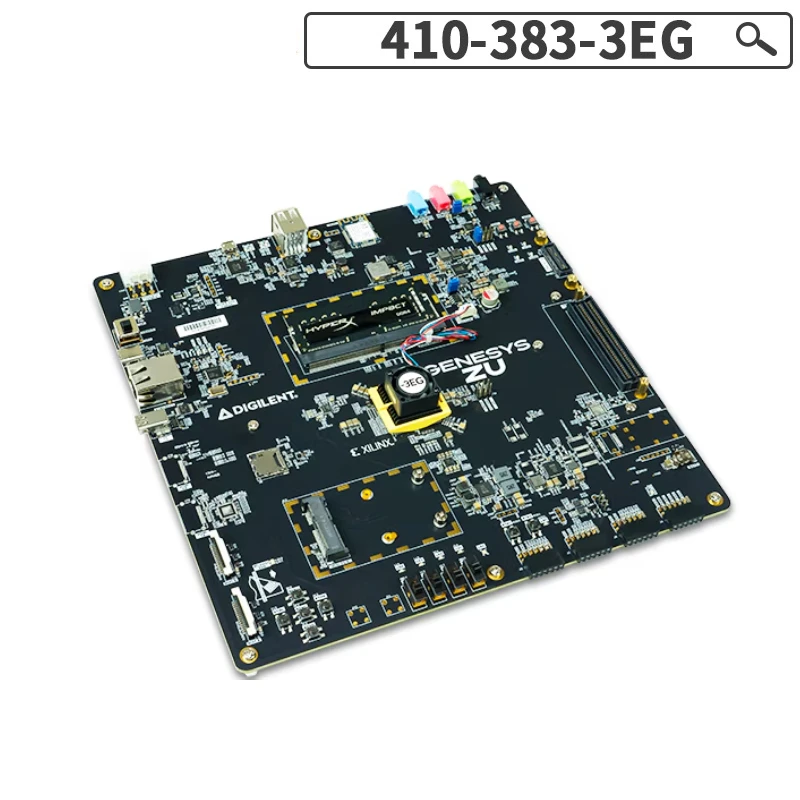
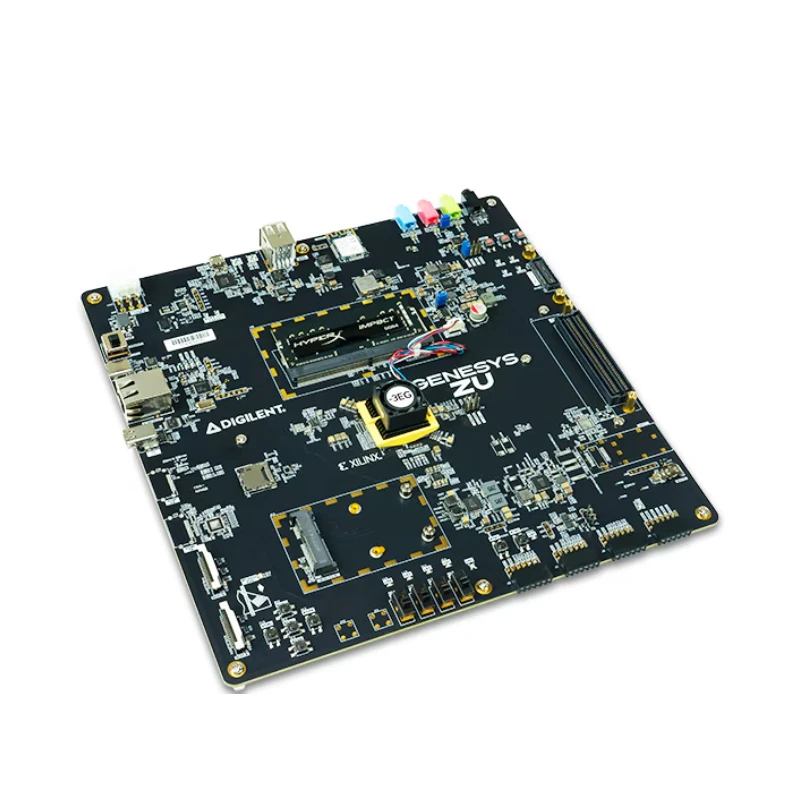
410-383-3EG (Genesys ZU-3EG) Product Information
First, the core parameters
- core chipXilinx Zynq UltraScale + MPSoC (Model)
XCZU3EG-1SFVC784E), integratedQuad Core Arm Cortex-A53(Up to 1.5GHz, supports heterogeneous computing),Dual Core Arm Cortex-R5(Up to 600MHz, real-time processing),Mali-400 MP2 GPU(Graphic rendering). - processing performance: 154k Logic Cells, 7.6Mb Block RAM, 360 DSP Slices, supports hardware acceleration and real-time signal processing.
- Storage Configuration: 4GB DDR4 RAM (1866/2133 MT/s, upgradeable), 256MB NOR Flash (boot and configuration), MicroSD card slot (104MB/s, storage expansion), optional mSATA SSD.
Second, technical parameters
- Interface and extension:
- high speed interface: 1 FMC expansion connector (compatible with high-bandwidth daughter cards), 1 SYZYGY port (supports Zmod high-speed modules, such as ADC/DAC), 4 Pmod ports (low-speed peripheral expansion).
- multimedia interface: Dual DisplayPort 1.2a (4K video output), dual Pcam camera interface (MIPI CSI-2), audio codec (supports microphone/speaker).
- communication interfaceUSB Type-C 3.1 Gen1 (dual role, data/power supply), 2 USB 2.0 Type-A host ports, 1G Ethernet (supports IEEE 1588 clock synchronization), 2.4GHz WiFi, MiniPCIe/mSATA dual slot (compatible with WWAN/LoRa modules).
- Power and cooling: 12V/8A desktop power supply (including PCIe interface), core chip with cooling fan (-40 ° C~ + 85 ° C industrial temperature range).
- development support: JTAG HS1 debugger (one-click burning), Linux (Petalinux) compatible with RTOS, available with MIPI CSI-2 IP kernel license.
Three, application scenarios
- Embedded vision and multimedia: 4K video codec, machine vision (such as medical endoscopes), automotive ADAS, real-time surveillance and video stream processing.
- Communication and network5G wireless infrastructure (baseband processing), cloud computing edge nodes, 1G/10G Ethernet device prototypes, software-defined radio (SDR).
- Industry and defenseSensor fusion (e.g. inertial/optical sensors), aerospace electronics (high reliability control), real-time data collection and processing (with Zmod modules).
- Education and prototype development: FPGA + SoC hybrid architecture teaching, AI edge computing prototype (deep learning inference), high-speed I/O and signal processing experiments (such as radar/ultrasound simulation).